This blog was originally started to better help me understand the technologies in the CCIE R&S blueprint; after completing the R&S track I have decided to transition the blog into a technology blog.

CCIE #29033

This blog will continue to include questions, troubleshooting scenarios, and references to existing and new technologies but will grow to include a variety of different platforms and technologies. Currently I have created over 185 questions/answers in regards to the CCIE R&S track!! Note: answers are in the comment field or within "Read More" section.

You can also follow me on twitter @FE80CC1E


Saturday, October 16, 2010

Question 139

What is the maximum diameter in EIGRP and what is the default value?

Friday, October 15, 2010

Question 138

How do you configure RIP to use unicast when performing updates?

Thursday, October 14, 2010

Question 137

When using EIGRP and the variance command and having 2 routes to a destination what is the * indicate in "show ip route"? You may need to lab it up. I would suggest to do a "show ip route" make note of the * do a ping then check it again.

Question 136

When doing "debug ip ospf packets" what do the following fields mean?


OSPF: rcv. v:2 t:1 l:48 rid:10.1.1.1
      aid:0.0.0.0 chk:3437 aut:0 auk: from 
serial 0/1

Wednesday, October 13, 2010

Question 135

What is the difference between "area # range" and "summary-address" ?

Tuesday, October 12, 2010

Troubleshooting 1

Determine what the issue/issues in the configuration below. Lab it up!


R1
__
interface loopback 0
 ip address 1.1.1.1 255.255.255.255
interface serial 1/0
 encapsulation frame-relay
 ip address 192.168.1.1 255.255.255.0
 frame-relay map ip 192.168.1.2 102 broadcast
 frame-relay map ip 192.168.1.3 103 broadcast
 ip ospf network-type point-to-multipoint

router ospf 1
 network 192.168.1.1 0.0.0.0 area 0
 network 1.1.1.1 0.0.0.0 area 0


R2
__
interface loopback 0
 ip address 2.2.2.2  255.255.255.255
interface serial 1/0
 encapsulation frame-relay
 ip address 192.168.1.2 255.255.255.252
 frame-relay map ip 192.168.1.1 201 broadcast
 frame-relay map ip 192.168.1.3 201
 ip ospf network-type point-to-multipoint

router ospf 1
 network 192.168.1.2 0.0.0.0 area 0
 network 2.2.2.2 0.0.0.0 area 0

R3
__
interface loopback 0
 ip address 3.3.3.3 255.255.255.255
interface serial 1/0
 encapsulation frame-relay
 ip address 192.168.1.3 255.255.255.0
 frame-relay map ip 192.168.1.2 301 broadcast
 frame-relay map ip 192.168.1.1 301 broadcast

router ospf 1
 network 192.168.1.3 0.0.0.0 area 0
 network 3.3.3.3 0.0.0.0 area 0

Question 134

How would you connect noncontiguous area's to area 0 ? You cannot use a virtual-link.


Monday, October 11, 2010

Question 133

How would you connect noncontiguous area's to area 0 ? You cannot use a tunnel interfaces.

Question 132

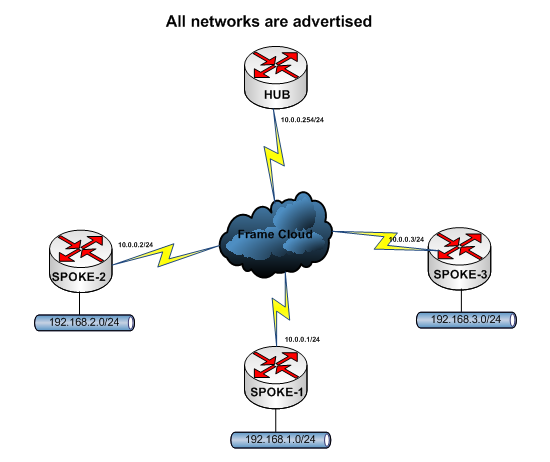
What should you be concerned with when running RIP or EIGRP in a hub and spoke frame-relay network?

Cisco umi


Thoughts?