This blog was originally started to better help me understand the technologies in the CCIE R&S blueprint; after completing the R&S track I have decided to transition the blog into a technology blog.
CCIE #29033
This blog will continue to include questions, troubleshooting scenarios, and references to existing and new technologies but will grow to include a variety of different platforms and technologies. Currently I have created over 185 questions/answers in regards to the CCIE R&S track!! Note: answers are in the comment field or within "Read More" section.
Well I have started the long process of becoming a CCIE in security. I am going to start right from the beginning (CCNA Security---> CCNP Security---> CCIE Security Written ---> CCIE Lab) to ensure that no topics are left unturned. I am not sure that I learned my lesson from the R&S track but I have to renew by May of 2013 so Security made the most sense.
A partner at Cisco shared this link with me showing the time differences between the deployment of blade servers. Cisco vs HP....imagine if you were deploying tens or hundreds of blades.
Master Selection - High Availability with Fortinet
Master (also known as the Primary) is chosen based on the following
monitored port - (highest number of connected non failed monitored interfaces)
system up time (age) - (longest up-time)
unit priority - (default 128 - higher priority is selected as Master)
serial number - (highest serial number)
As soon as the FGCP protocol hits the first criteria that meets the requirement of the master selection process the rest of the evaluation process is no longer evaluated and the master node is selected.
I know its been awhile and I am looking forward to posting again. I most recently have been asked to look deeper into Brocade so I looked up their certification path and was surprised to find the following
I have heard some engineers and administrators claim that their systems are available 100% of the time. I wanted to ensure that there is a clear understanding on what 100% availability means. Up-time does not equal availability; you can have a system that is up but the services may not be available. You also need to consider maintenance windows as this impacts your overall availability. If you do not have the ability to do maintenance without impacting the services that you are providing then your overall availability percentages take a hit. Other things that may impact your ability of achieving 100% availability includes environmental's such as power, cooling, etc and other services that are required to provide access to the very services that you are providing such as internet connectivity, WAN, LAN, SAN, etc....
Below is a chart showing the availability percentages and the expected downtime per year based on these percentages.
So.....are you really providing 100% availability?
In vSphere 5.0 the concept of 5 primary/secondary hosts has been eliminated and the concept of master/slave exists. A single host is the master and all other hosts are slaves, if the master fails then an election process is kicked off and a new master is elected.
This eliminates issues in previous versions of VMware where the primary/secondary concept existed and we needed to consider
Number of hosts in a cluster
Managing the role of the host
Number of consecutive host failures
Placement of hosts across blade chassis and stretched clusters
Partition scenarios likely to occur in stretched cluster environment
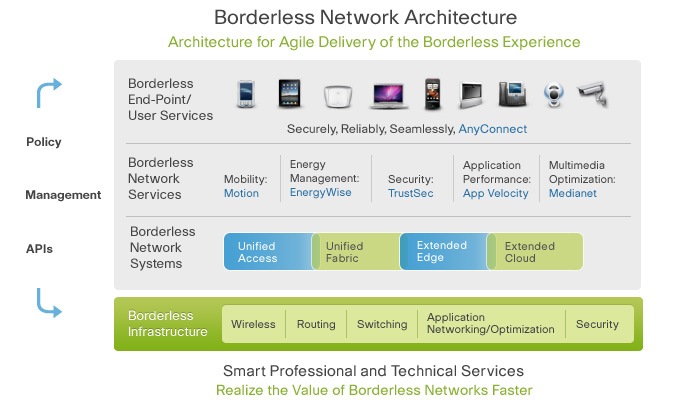
Cisco's borderless networks provides secure, seamless, and reliable connectivity to anyone, anywhere, anytime to anything. Borderless network architecture is a technical architecture that allows organizations to realize these benefits.
I can’t even start imagining how much time Vincent Bernat spent creating
his interactive introduction to the spanning tree protocol (starting with
STP im...
A new storage account classification called Standard Provisioned v2 changes
how we size Azure Files for FSLogix. Instead of buying capacity to buy
IOPS, ...
The debates around IP multicast stopped about five to ten years ago AFAICT.
No one wants to deal with it anymore. In theory, IP multicast was a good
idea b...
Please join us in congratulating the following iPexpert students who have
passed their CCIE lab! This Week’s CCIE Success Stories Lucas
Handybiantoro, CCIE...
It’s official, the CCIE DC has been announced. Here’s the meat of the
announcement: “Cisco announced today that a new expert-level certification
for data c...
A dynamic, innovative, and skilled individual that is passionate about technology providing technical leadership and architectural oversight. I have in depth knowledge in a variety of technologies which provides a holistic overview of the environment and allows for superior solutions. I take business challenges and create IT solutions that are highly available, scalable, and secure. I have the ability to translate business objectives into IT initiatives. I have a continued thirst for knowledge and share that knowledge with colleagues, business partners, and vendors. I make contributions to the IT community participating in seminars, online forums, and actively blogging.